
If you source agricultural blades or tiller parts, you’ve almost certainly been offered products at significantly different price points from different suppliers. And you may have wondered: is the quality difference real, or is it just marketing?
The answer isn’t about price tier or country of origin. It’s about whether a supplier can verify what they’re selling you.
This article gives you four specific questions to ask any supplier — questions that quickly separate those who control their process from those who don’t. The answers will tell you more than a price sheet or a factory photo ever will.
The Price Gap Is Real — So Is What Causes It
Low price agricultural blades are typically 10–30% cheaper than any equivalent products all around the world. That gap is not imaginary, and it’s not purely due to labor cost differences. It reflects real differences in:
- Raw material grade and traceability
- Manufacturing process
- Heat treatment consistency
- Quality control investment
Understanding each of these helps you ask the right questions when evaluating any supplier.
1. Raw Material: The Foundation of Blade Quality
Agricultural blades require alloy steel with specific properties — primarily high carbon content for hardness, and manganese or chromium content for toughness and wear resistance. Common specifications include grades like Spring steel, Alloy steel and Boron steel.
In practice, the issue is not which grade is specified — it’s whether the steel delivered matches the specification.
Taiwanese manufacturers, source steel primarily from Japanese mills and Taiwanese mills with full material certification. Mill test reports are standard, and the same steel grade from a Japanese and Taiwanese mill has very tight composition tolerances.
In the Budget supply chain, the steel grade specified in a product listing and the steel actually used in production can differ — especially at lower price points. This is a documented sourcing risk that experienced buyers account for.
What to ask any supplier: Can you provide mill certificates (MTR/MTC) for the specific steel batch used in my order?
2. Manufacturing Process:
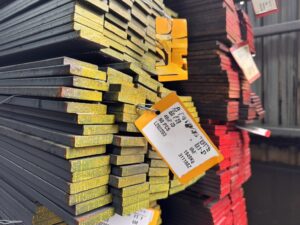
Hot forging produces a blade with refined grain structure, aligned fiber flow, and higher fatigue resistance, it requires more capital investment (furnaces, forging equipment, die maintenance) and longer cycle times.
Every Taiwanese agricultural blade — use hot forging as the standard process. This is partly historical: Taiwan’s agricultural machinery industry developed alongside rice farming, which demands blades that handle wet, clay-heavy soils. The durability requirement drove process investment.
What to ask: Is this blade hot forging or rolling production considered of the metallographic flow?

3. Heat Treatment: Where Blades Fail or Last
A blade that is correctly forged but incorrectly heat treated will fail early. Heat treatment — quenching and tempering — determines the final hardness (HRC) and toughness balance of the blade.
The target for most agricultural blades is HRC 40–48, depending on application.
Too soft and the cutting edge wears quickly.
Too hard and the blade becomes brittle and chips under impact.
Achieving consistent heat treatment requires:
- Calibrated furnaces with temperature uniformity
- Controlled quenching media and timing
- Tempering process to reduce brittleness
This is where the greatest inconsistency appears in lower-cost production. Surface hardness can be spot-checked easily, but through-hardness and consistency across a batch require proper process control.
What to ask: What kind of heat treatment do you used with the blades? and How long do the time spend on each product?
4. Quality Control and Traceability
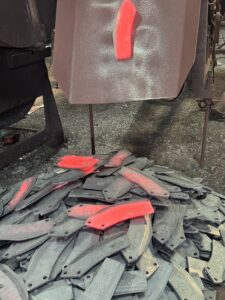
When a batch of blades fails in the field — early wear, edge chipping, breakage — traceability matters. Can the supplier identify which steel batch, which production run, and which process parameters produced that batch?
Suppliers with documented QC systems can trace failures and correct them.
When Lower-cost Blades Make Sense
To be direct: for some applications, lower-cost blades are the right choice.
- Light-duty tillers in sandy or loose soil conditions
- Markets where price sensitivity is the dominant customer concern
- Replacement parts for older, low-horsepower machines where blade life is less critical
If your customers are asking for the cheapest available replacement blade and longevity is not a primary concern, Taiwanese-made blades may be overspecified for that market.
When Taiwan-Made Blades Justify the Premium
- Heavy clay, compacted, or rocky soil conditions
- Mid and High-horsepower commercial tilling operations
- OEM supply to machinery brands with quality standards
- Markets where blade failure has high downstream cost (labor, downtime, reputation)
- Customers who have experienced quality issues with lower-cost blades and are looking for a reliable alternative
In these contexts, the longer service life of a hot-forged, properly heat-treated blade typically delivers lower total cost of ownership — even at a higher unit price.
Summary
| Factor | Lowest-cost | Lower-cost | Taiwan (HwaYung) |
|---|---|---|---|
| Steel traceability | Variable | Available on request | Mill cert standard |
| QC | none | half day/ per day | per hour |
| Heat treatment | Outsourced / variable | In-house at quality tier | In-house, all batches/ Outsourced (passed IATF16949) |
| OEM capability | Limited | Available | Full OEM/ODM |
| Price | Lowest | Mid | Mid / Mid-high (depends on quantity) |
| Best for | Light duty, price-sensitive | Mid-duty | Mid & Heavy duty, OEM, reliability |
How to Evaluate Any Supplier
Regardless of country of origin, ask these four questions:
- Can you provide steel mill certificates for my each order?
- How many times of QC per day?
- What kind of heat treatment do they used? and how long ?
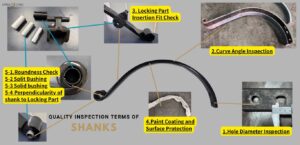
- What is your QC process for dimensional inspection and hardness testing?
- Material + QC + Heat Treatment + OEM capbility (Facility & Experience)

HwaYung Steel Industrial CO., LTD. | Est. 1960 | Pingtung, Taiwan [email protected] | hwayungblades.com | D-U-N-S: 65-830-9088